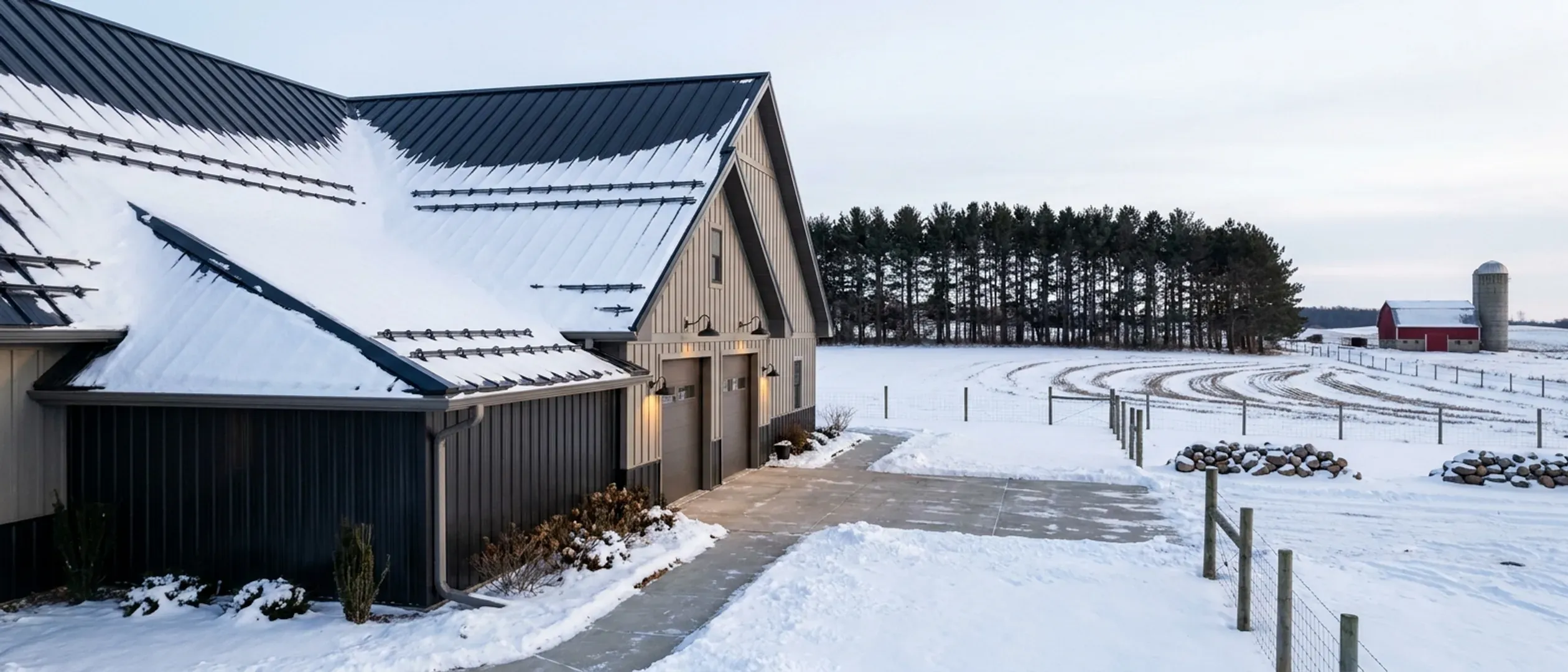
How Long Does It Take to Build a Barndominium in Wisconsin? Permits, Frost and the Building Season
Most timeline pages attach week counts to a list of stages and call it a schedule. This one does not, because the honest answer in Wisconsin depends more on the parcel and the season than on the building. What Wisconsin does give you is a set of fixed rules that decide the order of the work: the Uniform Dwelling Code applies to every new one- and two-family home in the state, the septic system has to be approved before the building permit can be issued, footings have to go below frost, and septic components cannot be installed in frozen soil. Those rules, not the steel or the posts, are what move a start date by months. Below is the sequence, what each step waits on, and where a Wisconsin winter bites.
Figures on this page are cited third-party or government data, not a quote from Wisconsin Barndominium Builders.
Bottom Line Up Front
- The shell is quick and the interior is not. Once the foundation is in, a pole barn (post-frame) or steel shell goes up and dries in fast; insulation, mechanicals, drywall and finishes take most of the calendar.
- On a rural lot the septic comes first. Wisconsin will not issue the uniform building permit for a home that needs a private septic system until the septic side has been approved (SPS 320.09), and soil testing and septic installation both stop when the ground is frozen (SPS 385.20, SPS 383.45).
- Winter changes the order, not the rules. Footings must sit below frost and at least 48 inches below grade and may not be placed on frozen material (SPS 321.16), so a start date should be planned around the ground, not the calendar page.
The stages, and what each one waits on
No week counts here. Each stage lists the thing it genuinely waits on, which is what to ask about when anyone gives you a date.
1. Land due diligence
Waits on the local zoning office and the permit issuer: whether a home is allowed on the parcel, setbacks, whether shoreland or floodplain zoning applies, driveway and access rules, and who administers the Uniform Dwelling Code there.
2. Survey, soil test and septic approval
Waits on a certified soil tester and on unfrozen ground. The septic design then needs approval before the building permit can issue. On a sewered city lot this stage largely disappears.
3. Plans, energy calculations and the building permit
Waits on complete plans and the other local prerequisites. Once everything required has been received, SPS 320.09(11) gives the issuer 10 business days to approve or deny the uniform building permit application. Incomplete submittals are the usual delay, not the review itself.
4. Site work, erosion control and utilities
Waits on weather and on utility locates: an excavator must notify the one-call system at least 3 working days before digging (Wis. Stat. 182.0175). Erosion and sediment controls have to be in place and maintained until the site is stabilised (SPS 321.125).
5. Footings and foundation
Waits on unfrozen or protected ground and the footing inspection. SPS 320.09(9)(b) lets footings and foundations start before the full building permit where a separate permit to start construction is obtained, which can help catch the end of a season.
6. Shell: frame, roof and walls
Waits on the kit or steel package arriving and on road access for heavy loads. This is the fast, visible stage.
7. Rough-ins and inspections
Waits on the trades and on inspections. Under SPS 320.10, work may not proceed past an inspection point until the inspection is done, unless it has not happened by the end of the second business day after notification.
8. Insulation, drywall, finishes and final
Waits on the trades and on your decisions. This is most of the calendar: a heated new home has to meet the energy chapter of the code (SPS 322), and finish selections made late are the most common cause of drift.
What a Wisconsin winter actually changes
Cold weather does not stop a build, but it reorders it and adds cost to some steps.
Ground-dependent work bunches into the unfrozen months
Soil testing, septic installation, excavation and footings all depend on the ground. If those are not done before freeze-up, the rest of the schedule tends to wait for spring.
A closed-in shell can keep working
Once the shell is dried in and temporary heat is available, interior work can continue through winter. Getting the roof on before the snow is a common scheduling goal for that reason.
Snow and frost affect the site, not just the crew
Snow cover must be removed before septic components are installed, and footings cannot bear on frozen material. Both add days that do not appear on a summer schedule.
Erosion control waits for green-up
A disturbed area counts as stabilised by vegetation only when perennial cover reaches at least 70 percent density (SPS 321.125), so controls placed in autumn usually stay until the grass comes back.
How to keep the schedule honest
The delays that matter are usually visible early. These checks catch them.
Ask who issues the permit before you buy
City, village, town, county or a State-contracted agency: each has its own forms and prerequisites.
Book the soil evaluation while the ground is open
If you are buying land in late autumn, try to get the soil evaluation done before the ground freezes, or plan on a spring start.
Confirm road access for heavy deliveries
Ask the town or county whether your road is weight-posted in spring, and whether the driveway entrance needs its own permit.
Make finish decisions before the shell goes up
The interior is where time goes; decisions made early keep the trades moving.
Ask for lien waivers with each draw
Wisconsin's lien law requires your prime contractor to include a lien-rights notice in the contract, and subcontractors and suppliers may send their own notices (Wis. Stat. 779.02). Ask for lien waivers with each draw.
Reading this because you are weighing a build? The next step is a plan drawn for your program.
What's different about Wisconsin
One code statewide, but the parcel decides who issues the permit
Wisconsin's Uniform Dwelling Code (Wis. Admin. Code chs. SPS 320 to 325) covers every new one- and two-family dwelling in the state. Who administers it depends on where the land is: the city, village or town; the county where the municipality has not taken it on; or, in some small municipalities, the State through a contracted inspection agency. The first scheduling question is therefore simply who issues the permit for your parcel, and what they ask for alongside it.
The septic must be approved before the building permit
SPS 320.09(9)(c) says that if the home needs a private onsite wastewater treatment system, a Wisconsin uniform building permit may not be issued until conformance with the septic rules has first been determined. On a rural parcel that makes the soil evaluation and septic approval the first real milestone, ahead of the building permit.
Frozen ground stops soil tests and septic installs
The soil evaluation for a septic system is done by a certified soil tester (SPS 385.10), and frozen soil must be thawed before its colour, texture, structure and consistence are evaluated (SPS 385.20). Septic treatment and dispersal components built partly in the native soil may not be installed if that soil is frozen at or below the infiltrative surface, and snow cover has to be removed first (SPS 383.45). A late-autumn land purchase can therefore wait for spring before the septic side moves.
Footings go below frost, and never onto frozen ground
SPS 321.16 requires footings and foundations to be placed below the frost penetration level or at least 48 inches below adjacent grade, whichever is deeper, and says footings may not be placed on frozen material. Winter foundation work is possible, but the ground has to be protected or thawed, which is extra time and cost. A frost-protected shallow foundation is allowed only when designed to ASCE 32.
Seasonal road weight limits can hold up deliveries
Under Wis. Stat. 349.16, the officer in charge of town, city or village roads, the county highway commissioner or committee, and the State for state highways may impose special weight limits on a road weakened by climatic conditions, posted by signs. Concrete trucks, truss loads and steel deliveries all run heavy, so ask the town or county highway department whether your access road is posted before you set a delivery date.
The permit has a clock once it is issued
SPS 320.09(9)(a)5. says the uniform building permit expires 24 months after issuance if the dwelling exterior has not been completed. Pulling the permit long before the site is ready spends that time.
Pros and cons, honestly
Pros
- The shell is genuinely fast. Once the foundation is ready and the package is on site, a post-frame or steel structure goes up and dries in quickly.
- One statewide dwelling code means the construction rules do not change from county to county, even though the permit issuer does.
- A permit to start construction can let footings and foundations begin before the full building permit is issued (SPS 320.09).
- Once the shell is closed in, interior work can carry on through winter.
Cons
- The interior of the living quarters is most of the calendar and little of the visible progress.
- On a rural parcel the septic approval has to come before the building permit, and soil evaluations and septic installs stop when the ground is frozen.
- Footings must go at least 48 inches below grade or below frost, whichever is deeper, and cannot be placed on frozen material (SPS 321.16).
- Seasonal road weight limits can delay heavy deliveries on posted town and county roads.
- The building permit expires after 24 months if the exterior is not complete.
How long does it take to build a barndominium in Wisconsin?
Can you build a barndominium in winter in Wisconsin?
How deep do footings have to be in Wisconsin?
Why does the septic system affect the building permit?
How long does the building permit review take?
How long is a Wisconsin building permit good for?
Do spring road limits really matter?
Questions answered? Tell us what you want to build and we will put real numbers against it.
Sources
- Wis. Admin. Code SPS 321.16 — frost protection (Uniform Dwelling Code)
- Wis. Admin. Code ch. SPS 320 — UDC administration, permits and inspections (SPS 320.09, 320.10)
- Wis. Admin. Code SPS 321.125 — erosion control and sediment control
- Wis. Admin. Code ch. SPS 383 — private onsite wastewater treatment systems (SPS 383.45 installation)
- Wis. Admin. Code ch. SPS 385 — soil and site evaluations
- Wis. Stat. 349.16 — authority to impose special or seasonal weight limitations
- Wis. Stat. 182.0175 — damage to transmission facilities (one-call notice before excavation)
- Wis. Admin. Code ch. SPS 322 — energy conservation (Uniform Dwelling Code)
Keep reading
The pages that answer the next question this one raises.
Are barndominiums legal in Wisconsin?
The code, permit and septic rules that decide the front end of this schedule.
Read itSite preparation
Clearing, grading, the pad and utilities: the ground-dependent work winter reorders.
Read itPermitting help
Identifying who issues the permit for your parcel and assembling what they ask for.
Read itTurnkey builds
One team sequencing the whole build, from site to final inspection.
Read itTell us about your land
Start the short survey and we will look at your parcel, timing and plans.
Read itWant a real number instead of a range?
Start the survey and tell us about your land and what you want to build. Include the county, town and parcel ID if you have them, because in Wisconsin the permit jurisdiction, the soil and the well and septic answers change the budget more than the building does. The survey costs nothing.