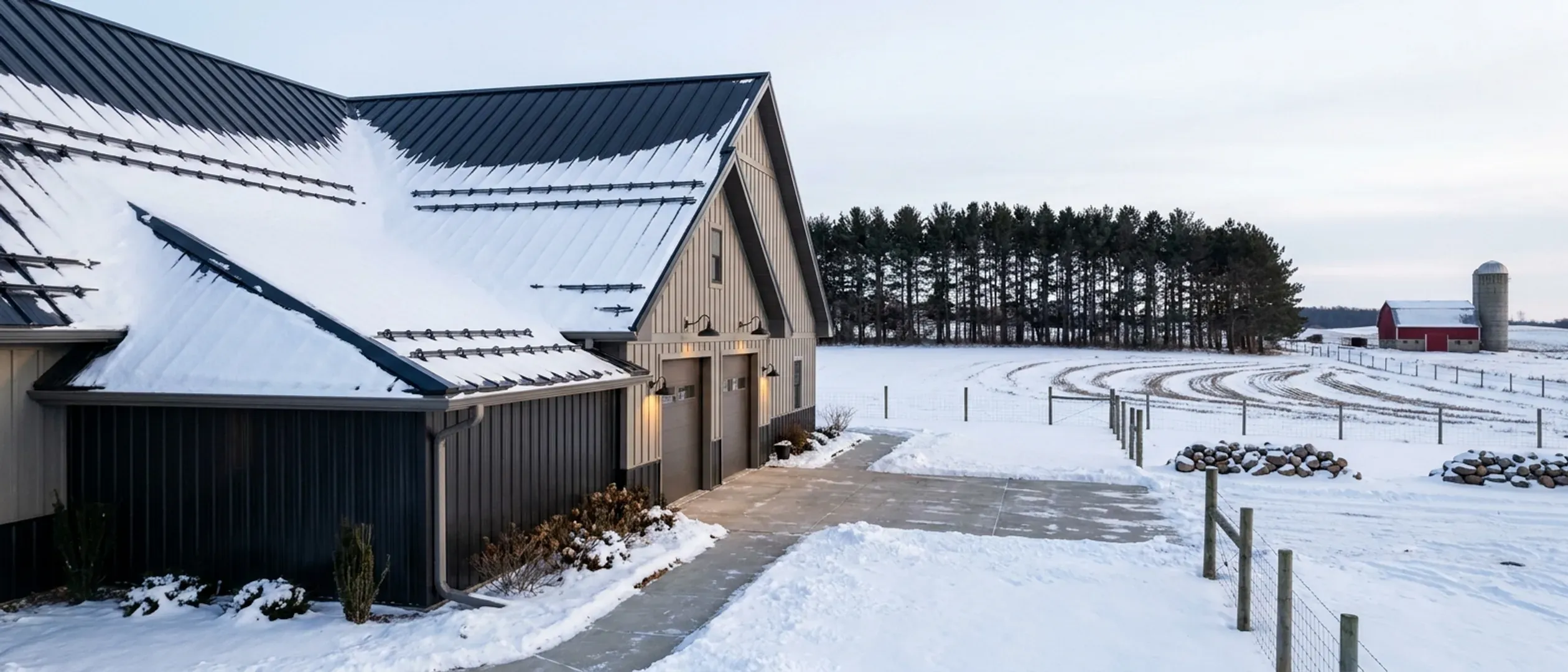
Are Barndominiums Legal in Wisconsin? The Uniform Dwelling Code, Permits, Septic and Zoning
Nothing in Wisconsin law singles out a barndominium. A post-frame or steel-framed building that people live in is a dwelling, and every new one- and two-family dwelling in the state is built to the same statewide code: the Uniform Dwelling Code, Wis. Admin. Code chapters SPS 320 to 325. That makes Wisconsin simpler than many people expect on the building side. The code is the same in every county, local governments must enforce it without changes, and there is no special approval track for the structural system. The questions that vary are the ones the code leaves alone: whether zoning allows a home on your parcel, whether shoreland or floodplain rules reach it, how the septic system will be permitted, and which office issues your building permit. This guide takes them in the order you will meet them.
Figures on this page are cited third-party or government data, not a quote from Wisconsin Barndominium Builders.
Bottom Line Up Front
- A barndominium is legal anywhere in Wisconsin a house is legal. With living quarters it is a dwelling under the Uniform Dwelling Code (SPS 320 to 325), which applies statewide and which local governments must adopt in its entirety.
- Living quarters end any farm exemption. The code exempts only buildings used exclusively for farm operations and not for human habitation (SPS 320.05(6)), and a barn converted to a home must meet the code (SPS 320.04(4)).
- Zoning, shoreland and floodplain rules, and the septic sanitary permit are where parcels differ. On land without sewer, the building permit cannot be issued until the septic side is in place (SPS 383.25(2)).
Can you live in a pole barn in Wisconsin?
Yes, if it is built or converted as a dwelling. The question is not the frame; it is whether the building is used for living in.
A building you live in is a dwelling
Wisconsin law defines a dwelling as any building that contains one or two dwelling units, and a dwelling unit as a structure or part of one used or intended to be used as a home, residence or sleeping place (Wis. Stat. 101.61(1)). A pole barn (post-frame) home with living quarters fits that definition and is built to the Uniform Dwelling Code.
The farm-building exemption stops at living quarters
The code does not apply to buildings used exclusively for farm operations and not for human habitation (SPS 320.05(6)). The moment a building has living quarters, that exemption is gone.
Converting a barn means meeting the code
SPS 320.04(4): a building previously used for another purpose, such as a barn or garage, shall comply with the code upon conversion to residential use. Building a shell as a barn and finishing it as a home later is a conversion, not a way around the code.
An attached shop is part of the dwelling
Attached garages, carports, porches, decks and similar structures attached to a dwelling are within the code's scope (SPS 320.02(1)(g)). A detached shop or garage is outside the dwelling code apart from the fire-separation rule in SPS 321.08(1) (SPS 320.05(4)), but local zoning and permits for it still apply.
Zoning: can a home go on this parcel at all?
Zoning is the first gate and it is local. Inside a city or village it is that municipality's zoning. On town land it may be county zoning, town zoning, or none, depending on the county and the town.
Town land: ask the county zoning office
A county zoning ordinance is not effective in a town until the town board approves it (Wis. Stat. 59.69(5)(c)), and a town may adopt its own zoning in some circumstances (Wis. Stat. 60.61, 60.62). The county zoning office can tell you which applies to a parcel.
Farmland preservation districts
If your land is in a farmland preservation zoning district, a home that is not a farm residence needs a conditional use permit and must meet state tests such as a 1-to-20 acreage ratio (Wis. Stat. 91.46).
Shoreland zoning
In Wisconsin, land within 1,000 feet of a lake or 300 feet of a river in a town is under county shoreland zoning; the state minimum setback for a new building is 75 feet from the ordinary high-water mark (Wis. Stat. 59.692; NR 115.05).
Floodplain zoning
Wisconsin requires every county, city and village to have floodplain zoning; a new home in the flood fringe must have its lowest floor at least 2 feet above the regional flood elevation (Wis. Stat. 87.30; NR 116). Check the floodplain map for the parcel before you buy.
The building code and the permit
Once zoning allows a home, the building side is uniform across the state.
Who issues the permit
Your Wisconsin uniform building permit comes from your city, village or town, from the county, or, in some small towns, from a State-contracted inspection agency; it must be issued before excavation starts (SPS 320.06, 320.08).
Plans and seals
The Uniform Dwelling Code does not require an architect's or engineer's seal on plans for a one- or two-family home, except for floodplain construction (SPS 320.09(6)(c)); Wisconsin law lets non-architects prepare plans for single-family homes and their outbuildings, including barns (Wis. Stat. 443.15). Engineered steel frames and engineered trusses come with the manufacturer's design.
Inspections
Plan review and inspections are done by inspectors certified by the State for the work they review (SPS 320.09, 320.10(1)).
The contractor's credential
The permit is pulled by the certified dwelling contractor on your build, or by you as an owner-occupant (Wis. Stat. 101.654; SPS 305.31).
Trades
Plumbing, electrical and HVAC are State-credentialed trades in Wisconsin (Wis. Stat. 145.06, 101.862, 101.178), so licensed trade contractors handle plumbing, electrical and HVAC.
Septic and wells
On rural land these usually decide the schedule and a good share of the site budget.
The sanitary permit comes first
On land without sewer, Wisconsin requires the POWTS sanitary permit before the building permit can be issued (SPS 383.25(2)).
Who issues it
The county issues sanitary permits (in Milwaukee County, the city, village or town) (Wis. Stat. 145.01(5)), after a State-certified soil tester evaluates the site (Wis. Stat. 145.045; SPS 305.33).
Who installs it
Under Wisconsin law a private onsite wastewater treatment system is part of plumbing (Wis. Stat. 145.01(10)), so it is designed and installed by the State-licensed plumbing trades, not by a general builder.
Private wells
Private wells in Wisconsin are drilled by DNR-licensed well drillers to the State well code, NR 812; some counties also issue well permits (Wis. Stat. 280.15; NR 812).
Rules the State sets for the building itself
Because the code is statewide, a few design figures are the same everywhere in Wisconsin.
Frost footings
Footings and foundations must be at least 48 inches below adjacent grade, or below the frost line if deeper (SPS 321.16), unless a frost-protected shallow foundation is designed to ASCE 32.
Roof snow load
Roofs are designed for the snow load on the Uniform Dwelling Code's zone map: 40 pounds per square foot in the northern zone and 30 in the southern zone (SPS 321.02, Figure 321.02).
Wind
Dwellings are designed for a horizontal and uplift pressure of 20 pounds per square foot, or for wind loads under ASCE 7-05 (SPS 321.02(1)(c)).
Energy
Heated homes must meet the UDC energy chapter, SPS 322, and an attached garage or shop that is heated has its own rules there (SPS 322.30(4)).
Using the shop
The shop is often the reason for building a barndominium. The dwelling permit covers it as part of the home, within limits.
Home occupations have limits
A home occupation inside a dwelling stays under the Uniform Dwelling Code only within limits: not more than 25% of the habitable floor area, and not involving motor-vehicle repair, explosives or fireworks (SPS 320.02(1)(cs)). Beyond that, the commercial building code (SPS 361 to 366) may apply, and your building department decides.
Fire separation from the house
The walls and ceiling between an attached garage and the living space need three-quarter-hour fire-resistive construction or one of the listed drywall assemblies (SPS 321.08(1)(a)).
Zoning still applies to the use
A business run from the shop can also need local zoning approval, separate from the building code.
Reading this because you are weighing a build? The next step is a plan drawn for your program.
What's different about Wisconsin
One dwelling code for the whole state
The Uniform Dwelling Code applies to all one- and two-family dwellings built since its effective date of June 1, 1980 (SPS 320.02, 320.03). It is Wisconsin's own code. A municipality may not adopt an ordinance on any subject within its scope (SPS 320.02(2)(a)), and one that enforces it must adopt it in its entirety (SPS 320.06(1)(a)2.).
The permit issuer depends on where the land is
Cities, villages and towns administer the code; a county ordinance applies in any city, village or town that has not enacted its own (Wis. Stat. 101.65(1)(a)); and in some municipalities of 2,500 people or fewer that neither enforce nor ask the county, the State provides inspection services through a registered UDC inspection agency (Wis. Stat. 101.651(3)(b); SPS 320.08).
Permit before excavation
A Wisconsin uniform building permit must be obtained before any on-site construction, including excavation for a structure, may begin (SPS 320.08(1)). A Wisconsin uniform building permit seal is affixed to the posted permit for each new dwelling (SPS 320.09).
The contractor who pulls the permit needs a State credential
Wisconsin requires the contractor who pulls the building permit for a new home to hold a State Dwelling Contractor certification and employ a certified qualifier (Wis. Stat. 101.654; SPS 305.31). Owner-occupants pulling their own permit are exempt.
The code does not decide zoning
SPS 320.02(2)(b) says the code does not affect local requirements on land use, zoning, setbacks and similar matters. Whether a home is allowed on a parcel is a separate, local question.
Septic first on unsewered land
A municipality may not issue a building permit for a structure that needs a private onsite wastewater treatment system (POWTS) unless the owner holds a sanitary permit for one, or an adequate system already serves it (SPS 383.25(2)(b); SPS 320.09(9)(c)).
Pros and cons, honestly
Pros
- Nothing in Wisconsin law treats a barndominium differently from any other house, so there is no special approval for a post-frame or steel frame.
- The building code is the same in every county, and local governments must enforce it without changes.
- Plans for a one- or two-family home need no architect's or engineer's seal outside floodplain construction.
- Every new home is plan-reviewed and inspected by State-certified inspectors.
Cons
- Once people live in it, the farm exemption no longer applies, so a barn shell finished later must meet the dwelling code.
- On unsewered land the septic sanitary permit has to come before the building permit.
- Zoning, shoreland and floodplain rules vary by parcel and can rule a site out.
- A shop used for a business can fall outside the dwelling code.
- The contractor who pulls the permit must hold a State Dwelling Contractor certification, so the permit applicant has to be chosen with that in mind.
Are barndominiums legal in Wisconsin?
Can you live in a pole barn in Wisconsin?
Can I call it a barn to avoid the dwelling code?
Do I need a building permit for a barndominium in rural Wisconsin?
Which building code applies to a barndominium in Wisconsin?
Does my contractor need a licence to build a barndominium in Wisconsin?
Do barndominium plans need a stamp or seal in Wisconsin?
What do I need for septic on rural land?
Can I build a barndominium near a lake?
Can I run a business from my barndominium shop?
Questions answered? Tell us what you want to build and we will put real numbers against it.
Sources
- Wis. Admin. Code ch. SPS 320 — Uniform Dwelling Code administration and enforcement
- Wis. Admin. Code SPS 320.05 — exempt buildings (farm-only use, detached accessory buildings)
- Wis. Admin. Code SPS 320.09 — procedure for obtaining the uniform building permit
- Wis. Admin. Code SPS 321.02 — loads and materials, snow load zone map
- Wis. Admin. Code SPS 321.08 — fire separation
- Wis. Admin. Code SPS 321.16 — frost protection
- Wis. Admin. Code ch. SPS 322 — energy conservation
- Wis. Stat. 101.61 — definitions (dwelling, dwelling unit)
- Wis. Stat. 101.65 — municipal and county jurisdiction over dwellings
- Wis. Stat. 101.651 — enforcement in small municipalities
- Wis. Stat. 101.654 — dwelling contractor certification
- Wis. Admin. Code SPS 305.31 — dwelling contractor certification
- Wis. Stat. 443.15 — exemptions (single-family dwellings and their outbuildings)
- Wis. Stat. 59.69 — county zoning and town board approval
- Wis. Stat. 60.61 — town zoning where no county ordinance
- Wis. Stat. 91.46 — farmland preservation zoning, conditional uses
- Wis. Stat. 59.692 — county shoreland zoning
- Wis. Admin. Code NR 115 — shoreland protection standards
- Wis. Stat. 87.30 — floodplain zoning
- Wis. Admin. Code NR 116 — floodplain management
- Wis. Admin. Code ch. SPS 383 — private onsite wastewater treatment systems
- Wis. Stat. 145.01 — definitions (governmental unit for POWTS, plumbing)
- Wis. Stat. 145.045 — soil tester certification
- Wis. Admin. Code NR 812 — well construction and pump installation
- Wis. Stat. 280.15 — well driller and pump installer registration and licensing
- Wisconsin DSPS — Uniform Dwelling Code program
Keep reading
The pages that answer the next question this one raises.
Permitting help
The service version of this guide: finding who regulates your parcel and assembling what they ask for.
Read itPole barn homes
Post-frame homes designed to the Uniform Dwelling Code from the start.
Read itHow long does it take to build?
How the septic, permit and frost rules set the schedule.
Read itBarndominium pros and cons
Snow loads, heated shops, condensation and appraisal.
Read itSite preparation
Clearing, grading and the pad, coordinated with the septic and well trades.
Read itTell us about your land
Start the survey and we will look at zoning, septic and permit questions for your parcel.
Read itWant a real number instead of a range?
Start the survey and tell us about your land and what you want to build. Include the county, town and parcel ID if you have them, because in Wisconsin the permit jurisdiction, the soil and the well and septic answers change the budget more than the building does. The survey costs nothing.