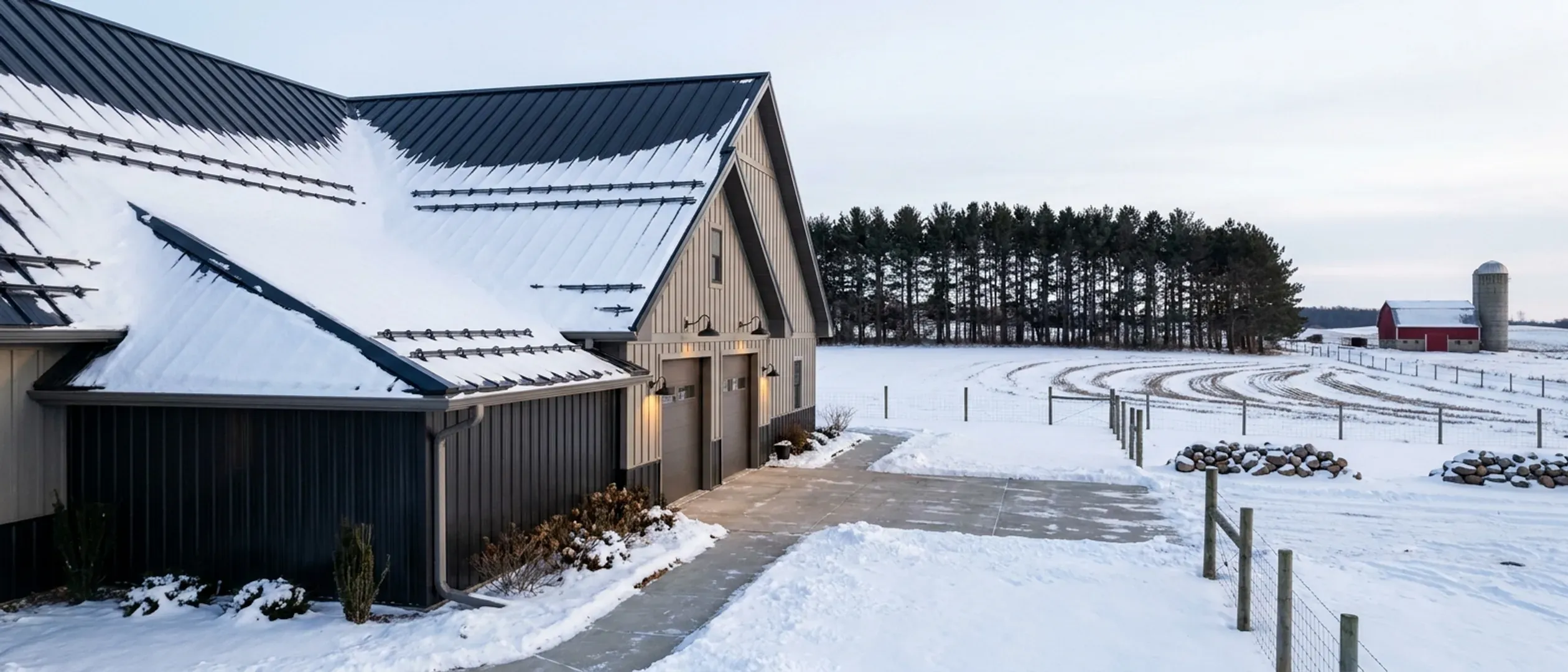
Are Barndominiums Worth It in Wisconsin? Land, Appraisal, Insurance and Heating
Whether a barndominium is worth it has less to do with the building than with what you would otherwise build. If you need a large shop and a house on the same rural land, putting both under one roof is hard to beat. If you would never build the shop, you are paying for space you do not need and a building some future buyers will discount. In Wisconsin a few specific factors sharpen the answer: the house site comes out of any farmland use-value assessment, rural appraisals can be thin on comparable sales, insurance treats a detached shop differently from an attached one, and the statewide energy code sets how well the living space has to be insulated for a long heating season.
Figures on this page are cited third-party or government data, not a quote from Wisconsin Barndominium Builders.
Bottom Line Up Front
- A barndominium is clearly worth it when you need a real shop and a house on the same land and would build both anyway.
- It is probably not worth it if you do not need the shop, want a conventional suburban resale profile, or are stretching to buy land that will not easily take a septic system.
- Run three checks before committing: how the lender's appraiser will value it, how the insurer will cover the shop, and what heating the whole building to Wisconsin's energy code will involve.
Where the answer is clearly yes
Each of these is a situation rather than a preference. If two or more describe you, a barndominium is very likely the right building.
You need a real shop, and would build one anyway
Equipment, vehicles, a trade, a boat or hobby space. Putting it under one roof with the house saves a second foundation, roof and envelope. If you would not otherwise build the shop, that saving does not exist.
You own or are buying suitable rural land
Zoned for a home, with road access and soil that will take a septic system. On that kind of parcel the building type is the easy part.
You want open, flexible space
Clear spans mean interior walls are not structural, so the layout can change as the household does.
You plan to stay
The shop-plus-house layout pays back in use over years. It is a weaker bet for a short hold.
Where the answer is probably no
None of these make a barndominium impossible, but each weakens the case.
You do not need the shop
Without the shop, a barndominium is a house with an unusual shell, and a conventional home may appraise and resell more easily.
The land is marginal for septic
A septic design has to be approved before the building permit can be issued (SPS 320.09), and difficult soils can change the system and the budget. Test before you buy.
You want a heated shop without the insulation
Heating an attached shop above 50 °F with a non-renewable source brings it under the energy code's garage rules (SPS 322.30), which means house-level insulation and thermal isolation.
Resale to a suburban buyer matters most
Buyers who do not want a shop may discount it, and rural comparables can be thin.
The value checks to run before you commit
Each of these can be done before you buy land or sign a contract.
Ask a lender how its appraiser will value it
Ask what comparables it expects to use and whether it lends on post-frame or steel-framed homes on acreage.
Get an insurance quote on the actual design
Show the insurer whether the shop is attached or detached and insure to replacement cost.
Ask the assessor how the parcel will be classified
If it is farmland now, find out how much will move out of the agricultural class for the homesite.
Get the soil tested
The septic system is the one site cost that can change the whole project, and it comes before the building permit.
Plan the heating for the whole building
Decide early which spaces are heated to living temperature and which are kept cool, because that decides insulation, fire separation and equipment.
Reading this because you are weighing a build? The next step is a plan drawn for your program.
What's different about Wisconsin
The house site is not farmland for property tax
Wisconsin assesses agricultural land on its rental income for farming (Wis. Stat. 70.32(2r)), but the statute defines agricultural land as land exclusive of buildings and improvements and the land necessary for their location and convenience (70.32(2)(c)1g.). Building a home on farmland therefore takes the homesite out of the use-value class. Ask the local assessor how your parcel will be split before you budget taxes.
Rural appraisals can be thin
Fannie Mae's Selling Guide notes that rural properties may have a shortage, or absence, of recent truly comparable sales nearby, and lets appraisers use older or more distant comparables with an explanation. A barndominium on acreage can have few direct comparables, which matters for how much a lender will lend.
Replacement cost, not market value, drives the insurance
Wisconsin's Office of the Commissioner of Insurance explains that full replacement cost coverage generally requires insuring the building at 80% to 90% of its replacement cost, and warns not to confuse replacement cost with market value. A well-built barndominium can cost more to replace than it would sell for, so insure to replacement cost, not to an appraisal.
Detached and attached shops are covered differently
The same OCI guide says coverage for other structures, such as a detached garage or any other building on the property, is usually 10% of the amount on the house. A shop that is part of the dwelling is covered with it; a large detached shop may need extra coverage.
Farm policies differ from homeowner policies
OCI notes that the usual farmowners policy does not provide replacement cost coverage on the dwelling unless you ask for it, and that crops, livestock and farm equipment usually need separate policies. If the barndominium sits on a working farm, check which policy covers it.
The energy code sets the heating baseline
A new Wisconsin home heated with any non-renewable energy must meet the energy chapter of the Uniform Dwelling Code, SPS 322 (SPS 322.01). SPS 322 Table 322.31-1 requires, for example, R-49 ceilings in every county, both the 15 far-northern counties and the rest of the state. The living space is insulated like any new house; how much of the shop you keep warm is the variable you control.
Pros and cons, honestly
Pros
- One building replaces a house and a separate shop, saving a second foundation, roof and envelope.
- Built to the same statewide Uniform Dwelling Code as any other Wisconsin home.
- Open, flexible interiors that can change over time.
- A shell that dries in quickly, before the snow.
Cons
- The value depends on needing the shop; without it, the case is weak.
- Rural appraisals can struggle to find truly comparable sales.
- The homesite leaves the agricultural use-value class for property tax.
- A heated attached shop has to meet the energy code's garage rules.
- A large detached shop may exceed the usual other-structures insurance limit.
Are barndominiums worth it in Wisconsin?
Do barndominiums hold their value?
Will building a barndominium change my farmland taxes?
How should I insure a barndominium?
Are barndominiums expensive to heat in Wisconsin?
Is a barndominium cheaper than a house?
Does the energy code apply to the shop?
Questions answered? Tell us what you want to build and we will put real numbers against it.
Sources
- Wis. Stat. 70.32 — real estate, how valued; agricultural land definition and use-value assessment
- Fannie Mae Selling Guide B4-1.3-08 — comparable sales, rural properties
- Wisconsin Office of the Commissioner of Insurance — Consumer's Guide to Homeowners Insurance
- Wisconsin Office of the Commissioner of Insurance — Insurance Tips for Farm Owners
- Wis. Admin. Code ch. SPS 322 — energy conservation, prescriptive insulation table
- Wis. Admin. Code SPS 322.30 — heated garages
- Wis. Admin. Code ch. SPS 320 — UDC administration, septic conformance before the building permit
Keep reading
The pages that answer the next question this one raises.
Barndominium pros and cons
The full list of strengths and weaknesses in a Wisconsin climate.
Read itBarndominium cost in Wisconsin
Third-party cost figures and what drives them.
Read itBarndominium financing
Loans, appraisals and what lenders look for.
Read itAre barndominiums legal in Wisconsin?
Code, permits, septic and zoning.
Read itShouses
The shop-plus-house layout this guide is mostly about.
Read itStart the survey
Tell us about your land and what the building needs to do.
Read itWant a real number instead of a range?
Start the survey and tell us about your land and what you want to build. Include the county, town and parcel ID if you have them, because in Wisconsin the permit jurisdiction, the soil and the well and septic answers change the budget more than the building does. The survey costs nothing.