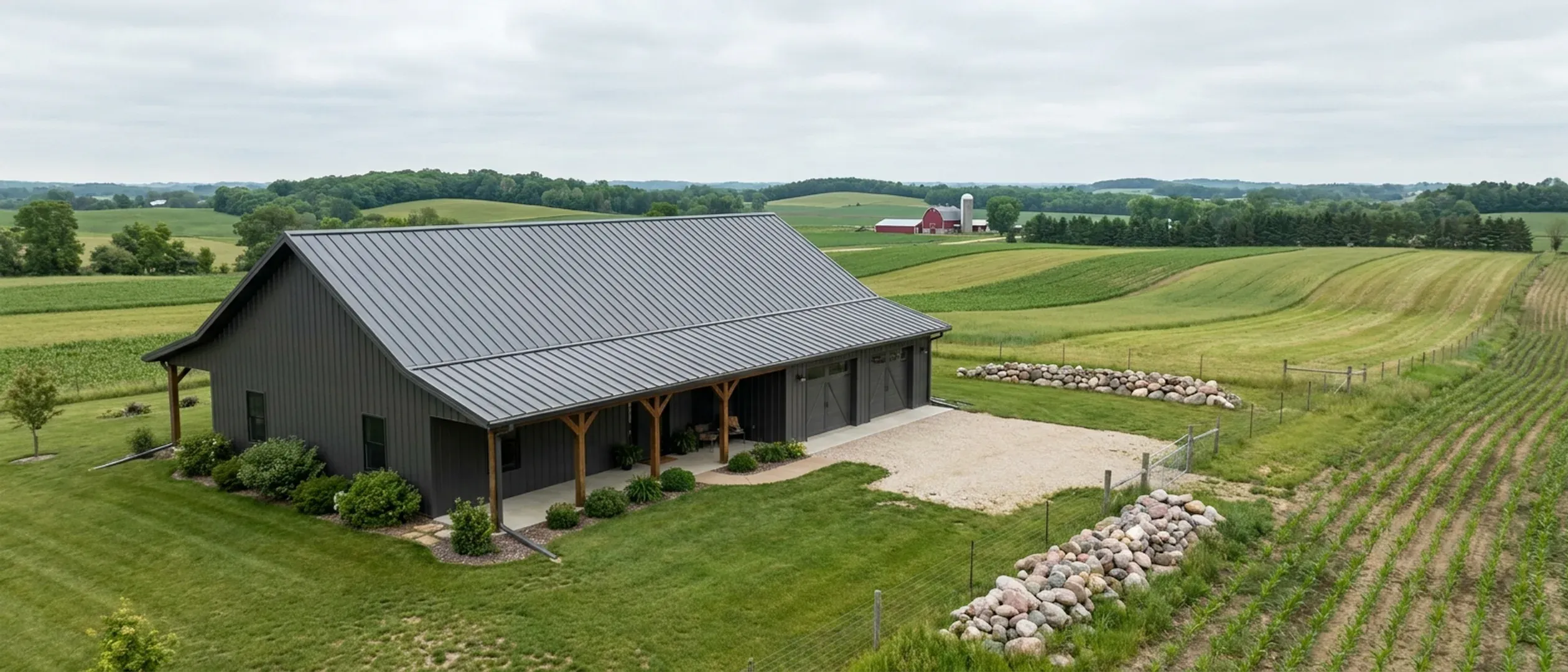
Cost to Build a Barndominium in Wisconsin
No government agency publishes a barndominium cost series, for Wisconsin or anywhere else. What does exist is solid: the Census Bureau's contract price for custom homes built on the owner's land in the Midwest, the permit valuations Wisconsin municipalities report for every new house, NAHB's line-by-line breakdown of what a house costs to build, USDA land values, and the fee schedules Wisconsin towns and counties publish. This guide puts those numbers side by side, then walks through the Wisconsin-specific items (48-inch footings under SPS 321.16, the two roof snow-load zones in SPS 321.02, private septic and wells, and permit fees) that decide where your own build lands.
Figures below are industry data from cited third-party sources, not a quote from Wisconsin Barndominium Builders. Every project is priced individually.
Bottom Line Up Front
- The closest published benchmark for a barndominium on your own land is the Census Bureau's contract price for contractor-built houses started in the Midwest in 2025: a median of $194.09 and an average of $202.13 per square foot, land excluded. No federal series separates barndominiums from other custom homes.
- Wisconsin municipalities reported 13,405 new single-family homes authorized in 2025 with a combined valuation of $5.61 billion, about $418,500 per home for the structure alone (Census Bureau Building Permits Survey, arithmetic ours).
- The Wisconsin-specific costs sit below grade and beside the house: the Uniform Dwelling Code sets footings at least 48 inches below grade (SPS 321.16), roofs carry a 30 or 40 psf snow load by zone (SPS 321.02), and a rural lot usually needs its own septic system and well. Census data puts both on 57% of contractor-built Midwest homes.
Published cost figures
Third-party and government figures, each with its source. None of them is a quote, and none of them is ours.
| Measure | Range | Source |
|---|---|---|
| Contractor-built houses on the owner's land, Midwest, started in 2025: median to average contract price (land excluded) | $194–$202 per sq ft | U.S. Census Bureau, Characteristics of New Housing 2025, Median and Average Contract Price per Square Foot of New Contractor-Built Single-Family Houses Started: Midwest median $194.09, average $202.13 (read 26 Sep 2026) — https://www.census.gov/construction/chars/xls/contractpricesqft_cust.xls |
| Detached new houses sold by builders, Midwest, 2025: median to average sales price (lot excluded) | $160–$170 per sq ft | U.S. Census Bureau, Characteristics of New Housing 2025, Median and Average Price per Square Foot of Floor Area in Detached New Single-Family Houses Sold: Midwest median $160.00, average $169.78 (read 26 Sep 2026) — https://www.census.gov/construction/chars/xls/soldpricesqft_cust.xls |
| Average construction cost alone (no lot, overhead, marketing or profit), national builder survey, 2024 | $162 per sq ft | NAHB, Cost of Constructing a Home 2024 (Eric Lynch, 20 Jan 2025): average construction cost $428,215, about $162 per square foot (read 26 Sep 2026) — https://www.nahb.org/news-and-economics/housing-economics-plus/special-studies/special-studies-pages/cost-of-constructing-a-home-in-2024 |
| Average permit valuation per new single-family home authorized in Wisconsin, 2025 (structure only) | $418,500 per home | U.S. Census Bureau, Building Permits Survey, annual 2025, State Units and State Value sheets: Wisconsin 1-unit, 13,405 units, valuation $5,609,893 thousand; per-home figure is arithmetic, rounded (read 26 Sep 2026) — https://www.census.gov/construction/bps/xls/stateannual_202599.xls |
| Average permit valuation per new single-family home, East North Central division, 2025 (structure only) | $372,000 per home | U.S. Census Bureau, Building Permits Survey, annual 2025: East North Central Division 1-unit, 76,996 units, valuation $28,641,558 thousand; per-home figure is arithmetic, rounded (read 26 Sep 2026) — https://www.census.gov/construction/bps/xls/stateannual_202599.xls |
| Wisconsin farmland, 2026 state average: pasture to cropland | $3,500–$7,600 per acre | USDA NASS, Land Values 2026 Summary (July 2026): Wisconsin pasture $3,500, cropland $7,600, farm real estate $6,700 per acre (read 26 Sep 2026) — https://www.nass.usda.gov/Publications/Todays_Reports/reports/land0726.pdf |
Estimate a range for your square footage
Pick a size and a tier and this multiplies them against the same industry ranges printed in the table above, nothing new, nothing ours. It's a starting orientation, not a quote.
Estimated range
$0 – $0
This estimate comes from the third-party cost data cited in the table above, not from Wisconsin Barndominium Builders. It doesn't account for your land, your county, or your finish choices, all of which move the real number. Start the survey with your parcel for one that does.
Total cost by size
Rough totals at common sizes. These move with everything on this page, so treat them as a starting orientation, not an estimate for your project.
1,500 sq ft
$291,000–$303,000
Arithmetic, rounded to the nearest $1,000: 1,500 sq ft × the Census 2025 Midwest contract price per sq ft for contractor-built houses ($194.09 median, $202.13 average), land excluded — https://www.census.gov/construction/chars/xls/contractpricesqft_cust.xls
2,000 sq ft
$388,000–$404,000
Arithmetic, rounded to the nearest $1,000: 2,000 sq ft × the Census 2025 Midwest contract price per sq ft for contractor-built houses ($194.09 median, $202.13 average), land excluded — https://www.census.gov/construction/chars/xls/contractpricesqft_cust.xls
2,400 sq ft
$466,000–$485,000
Arithmetic, rounded to the nearest $1,000: 2,400 sq ft (a 40x60 footprint, all living space) × the Census 2025 Midwest contract price per sq ft for contractor-built houses ($194.09 median, $202.13 average), land excluded — https://www.census.gov/construction/chars/xls/contractpricesqft_cust.xls
3,000 sq ft
$582,000–$606,000
Arithmetic, rounded to the nearest $1,000: 3,000 sq ft × the Census 2025 Midwest contract price per sq ft for contractor-built houses ($194.09 median, $202.13 average), land excluded — https://www.census.gov/construction/chars/xls/contractpricesqft_cust.xls
What actually moves the number
What is finished inside
NAHB's 2024 survey puts interior finishes at 24.1% of construction cost and plumbing, electrical and HVAC rough-ins at another 19.2%. A steel or post-frame shell does not change either number, so the finish list moves a barndominium budget more than the frame does.
Footings and basements
Wisconsin's Uniform Dwelling Code puts footings at least 48 inches below adjacent grade, or below the frost line if deeper (SPS 321.16). Once you dig that deep, a basement is a common next step: 55% of contractor-built Midwest homes completed in 2025 had a full or partial basement, according to the Census Bureau.
Septic and well
Rural lots rarely have sewer or water mains. The Census Bureau counts 66% of contractor-built Midwest homes completed in 2025 on an individual septic system and 57% on both a private septic system and a private well. Both costs come before the house does.
Snow-load zone
The Uniform Dwelling Code's zone map (SPS 321.02, Figure 321.02) sets a 40 psf roof snow load in the northern zone and 30 psf in the southern zone. The truss and purlin package is sized to the zone your county sits in, which is one reason a kit price quoted for another region may not transfer.
Why the Census contractor-built figure is the one to start with
A barndominium is almost always a custom home on land the owner already holds. The Census Bureau publishes a price series for exactly that arrangement.
What "contractor-built" means
The Census Bureau defines contractor-built houses as homes built for owner occupancy on the owner's land under the supervision of a general contractor, and its contract price excludes the value of the improved lot. That is the barndominium arrangement: your land, your contract, your house. In the Midwest in 2025 the median contract price was $457,200 and the average $546,100, according to the Census Bureau.
Why it is a Midwest figure
The Characteristics of New Housing tables are published for four regions, not for individual states. Wisconsin falls in the Midwest region and the East North Central division. The Midwest per-square-foot figure is the most specific published price series that matches a custom home on owner-held land.
The Wisconsin permit number is a cross-check
The Building Permits Survey is state-level. Wisconsin's 2025 permit valuations work out to about $418,500 per new single-family home, against about $372,000 across the East North Central division (Census Bureau, arithmetic ours). The Census Bureau describes valuation as the estimated value of the structure shown on the permit, so it excludes land and depends on what each applicant reported.
What the benchmark does not tell you
A median is the middle house, not your house. The Census contract price covers whatever each contract included, and Midwest contractor-built homes are large: a median of 2,289 square feet in 2025, per the Census Bureau. A smaller barndominium with a simple finish list can land well under the median total and still sit near the median per square foot.
Where the money in a house actually goes
NAHB's 2024 Cost of Constructing a Home survey breaks the average national build into eight stages. Its figures are national averages, and NAHB notes its sample is too small for regional detail, but the shares show which choices matter.
The shell is a minority of the cost
NAHB puts framing, including the roof structure, trusses and sheathing, at 16.6% of construction cost in 2024 and exterior finishes at 13.4%. Those are the stages a steel or post-frame barndominium shell replaces. The other seven-tenths of the budget is foundation, systems, interior finishes and site work, and those are priced the same way whatever the frame is.
Finishes and systems are the biggest lines
Interior finishes are the largest stage in NAHB's 2024 survey at 24.1% of construction cost, followed by major system rough-ins at 19.2%. Cabinets, flooring, fixtures, wiring, plumbing and ductwork are where a barndominium budget is won or lost.
Foundations and site work
Foundations are 10.5% of construction cost and site work 7.6% in NAHB's 2024 survey. In Wisconsin both stages carry more weight on a rural lot, because of the 48-inch footing depth in SPS 321.16 and because the septic system, well and driveway belong to your project rather than to a subdivision developer.
Construction cost is not the sales price
In NAHB's survey, construction was 64.4% of an average sales price of $665,298; the finished lot was 13.7% and builder profit 11.0%. Comparing a barndominium contract with a new-house listing price compares two different things, which is why this page leads with the contract figure.
Wisconsin fees: two published examples
Permit and sanitary fees are small next to construction cost, but they are real, they are published, and they differ by jurisdiction. These are two examples, not a statewide rate.
A town building permit schedule
The Town of Cedarburg's 2026 fee schedule charges $0.36 per square foot for residential construction including attached garages and finished areas, a $150 plan review for a new house, a $140 erosion-control base fee, $50 for the Wisconsin State Seal, and $55 plus $0.055 per square foot each for the electrical, plumbing and HVAC permits. Applied to a 2,400 square foot home, those lines total about $1,765 before the per-area erosion charge, occupancy permit and house number (arithmetic ours, from the town schedule).
A county sanitary permit schedule
Winnebago County lists a $700 sanitary permit fee for at-grade, mound and holding tank systems, which it says includes a mandatory $100 state fee, plus a $250 system review fee for at-grade, mound and in-ground pressurized systems. Those are permit fees only. The system itself, the soil evaluation work and the installer are separate costs.
The State seal
SPS 302.34 sets a $30 fee for each Wisconsin Uniform Building Permit Seal, which municipalities and inspection agencies buy for every new dwelling. Local schedules often pass it on as its own line, as the Town of Cedarburg schedule does at $50.
Where national permit-fee figures come from
NAHB's 2024 survey reports average building permit fees of $7,640, impact fees of $6,367 and water and sewer inspection fees of $6,260 per home nationally. Those averages are dominated by suburban subdivisions with utility connections. A rural Wisconsin parcel on its own septic system and well pays a different mix: fewer connection fees, more on-site work.
Land: what USDA and DATCP say an acre is worth
The Census contract price excludes land. If you do not already own the parcel, land is a separate line, and Wisconsin publishes two useful series.
USDA farmland averages
USDA's National Agricultural Statistics Service puts Wisconsin farm real estate at $6,700 per acre in 2026, cropland at $7,600 and pasture at $3,500. These are statewide averages of farmland, not building lots.
Wisconsin agricultural land sales
The Wisconsin Department of Agriculture, Trade and Consumer Protection reports that agricultural land sold in 2025 without buildings and staying in agricultural use averaged $9,057 per acre, while forest land staying in forest averaged $3,952. Land diverted to other uses averaged $44,692 per acre, but that figure rests on 20 transactions and swings widely from year to year in the same report.
Lot size on custom builds
The median lot under a contractor-built Midwest home completed in 2025 was 59,497 square feet, about 1.4 acres, and 76% of those lots were 22,000 square feet or larger, according to the Census Bureau. Barndominium buyers who want a shop and outbuildings usually buy more than that.
What land prices leave out
A per-acre price does not include the soil evaluation for a septic system, a driveway and culvert, a well, electric service to the building site or a survey. On raw land those items can add up to more than the land itself, which is why the survey at the end of this page asks where your parcel is before anything else.
Reading this because you are weighing a build? The next step is a plan drawn for your program.
What's different about Wisconsin
One statewide dwelling code
Every new one- or two-family dwelling in Wisconsin is built to the Uniform Dwelling Code, Wis. Admin. Code chs. SPS 320 to 325, and a municipality may not adopt its own ordinance on a subject the code covers (SPS 320.02). A barndominium that is a home is a dwelling under that code, so its structural, energy and inspection requirements are the same whether it sits in Waukesha County or Oneida County. What varies is the fee and who collects it.
Frost and snow are set in the code, not guessed
Two design figures that drive cost are written into the code itself: footings at least 48 inches below adjacent grade or below frost penetration if deeper (SPS 321.16), and a roof snow load of 40 psf or 30 psf depending on the zone map in SPS 321.02. A county in the northern zone, such as Marathon, Portage or Oneida County, carries the heavier figure; Dane, Brown and the Southeast counties sit in the 30 psf zone (SPS 321.02).
Permits come from the city, village, town or county
The Wisconsin uniform building permit is issued by whichever body enforces the code for your parcel: the city, village or town, the county where a county ordinance applies, or a State-contracted inspection agency where neither enforces (SPS 320.06). Each sets its own fee schedule. On top of the local fee, SPS 302.34 sets a $30 fee for the Wisconsin Uniform Building Permit Seal that is bought for each new dwelling.
The contractor who pulls the permit needs a State credential
Wisconsin requires the contractor who pulls the building permit for a new home to hold a State Dwelling Contractor certification (Wis. Stat. 101.654); owner-occupants pulling their own permit are exempt. The certificate requires a bond or liability insurance, which is part of every builder's overhead.
Heating and insulation are part of the code
Heated homes must meet the UDC energy chapter, SPS 322, so a barndominium living area is insulated and sealed to the same standard as any new Wisconsin house; an uninsulated metal shell is not an option for the living space. Fuel is a budget question too: 79% of contractor-built Midwest homes completed in 2025 heat with gas, a Census category that includes both natural gas and propane, and a rural lot without a gas main means a propane tank or an all-electric system.
Pros and cons, honestly
Pros
- A steel or post-frame shell replaces the framing and exterior stages, which NAHB puts at about 30% of construction cost combined in 2024.
- Clear-span framing lets you build a large shop or garage under the same roof as the living space.
- Frost depth, snow load and inspections are set by one statewide code, so the design rules do not change from county to county.
- You can often build on land you already own, keeping the lot cost out of the budget entirely.
Cons
- No published cost series isolates barndominiums, so every budget starts from general custom-home data.
- Footings at least 48 inches deep (SPS 321.16) and a septic system and well on a rural lot add cost that a city lot does not carry.
- Northern-zone roofs are designed for 40 psf of snow (SPS 321.02), and the structure is priced accordingly.
- Appraisers may have few barndominium sales to compare against, which can affect how much a lender will finance.
What is the average cost to build a barndominium in Wisconsin?
How much does a 40x60 barndominium cost in Wisconsin?
Is a barndominium cheaper to build than a regular house in Wisconsin?
How deep do barndominium footings have to be in Wisconsin?
What snow load does a Wisconsin barndominium roof have to carry?
How much are building permit fees for a new home in Wisconsin?
Does the cost include land, a well and septic?
How do I get a real number for my land?
Questions answered? Tell us what you want to build and we will put real numbers against it.
Sources
- U.S. Census Bureau — Median and Average Contract Price per Square Foot of New Contractor-Built Single-Family Houses Started (Characteristics of New Housing, 2025) — Midwest 2025: median $194.09, average $202.13 per sq ft, lot excluded. Read 26 Sep 2026.
- U.S. Census Bureau — Median and Average Contract Price of New Contractor-Built Single-Family Houses Started — Midwest 2025: median $457,200, average $546,100. Read 26 Sep 2026.
- U.S. Census Bureau — Median and Average Price per Square Foot of Floor Area in New Single-Family Houses Sold — Detached, Midwest 2025: median $160.00, average $169.78. Read 26 Sep 2026.
- U.S. Census Bureau — Square Feet of Floor Area in New Single-Family Houses Completed — Contractor-built, Midwest 2025: median 2,289 sq ft, average 2,471. Read 26 Sep 2026.
- U.S. Census Bureau — Type of Foundation in New Single-Family Houses Completed — Contractor-built, Midwest 2025: full or partial basement 55%, slab 35%, crawl space 10%. Read 26 Sep 2026.
- U.S. Census Bureau — Type of Sewage System by Water Supply Source in New Single-Family Houses Completed — Contractor-built, Midwest 2025: 66% individual septic system; 57% individual septic and individual water. Read 26 Sep 2026.
- U.S. Census Bureau — Lot Size of New Single-Family Houses Completed — Contractor-built, Midwest 2025: median lot 59,497 sq ft; 76% of lots 22,000 sq ft or more. Read 26 Sep 2026.
- U.S. Census Bureau — Building Permits Survey, annual state units and valuation, 2025 — Wisconsin 1-unit: 13,405 units, $5,609,893 thousand. East North Central Division 1-unit: 76,996 units, $28,641,558 thousand. Read 26 Sep 2026.
- U.S. Census Bureau — Building Permits Survey definitions (valuation) — Valuation is the estimated value of the residential structure as shown on the building permit. Read 26 Sep 2026.
- NAHB — Cost of Constructing a Home 2024 (Eric Lynch, 20 Jan 2025) — Construction cost $428,215, about $162 per sq ft; stage shares. Read 26 Sep 2026.
- USDA National Agricultural Statistics Service — Land Values 2026 Summary — Wisconsin 2026: farm real estate $6,700, cropland $7,600, pasture $3,500 per acre. Read 26 Sep 2026.
- Wisconsin DATCP and USDA NASS — Wisconsin Agricultural Land Sales 2025 — Land continuing in agricultural use $9,057 per acre; diverted to other uses $44,692 (20 transactions); forest continuing $3,952. Read 26 Sep 2026.
- Wis. Admin. Code SPS 321.16 — Frost protection (Uniform Dwelling Code) — Footings at least 48 inches below adjacent grade or below frost penetration, whichever is deeper.
- Wis. Admin. Code SPS 321.02 — Loads and materials, snow load zone map (Figure 321.02) — Zone 1 40 psf, Zone 2 30 psf.
- Wis. Admin. Code SPS 302.34 — Uniform Building Permit Seal fee — $30.00 per seal, one per new dwelling. Read 26 Sep 2026.
- Town of Cedarburg — 2026 Building Permit Fee Schedule (Resolution 2025-8) — Residential $0.36 per sq ft; plan review $150; erosion base $140; State Seal $50; electrical, plumbing and HVAC $55 + $0.055 per sq ft each. Read 26 Sep 2026.
- Winnebago County — Sanitary System Information (sanitary fees) — Sanitary permit $700 including $100 state fee; system review $250. Read 26 Sep 2026.
- U.S. Census Bureau — Type of Heating Fuel Used in New Single-Family Houses Completed — Contractor-built, Midwest 2025: gas 79% (natural gas and bottled or liquefied petroleum gas), electricity 18%. Read 26 Sep 2026.
- Wis. Admin. Code ch. SPS 322 — Energy conservation (Uniform Dwelling Code) — The UDC energy chapter for heated one- and two-family dwellings.
Keep reading
The pages that answer the next question this one raises.
Barndominium vs. house cost
Where a barndominium saves money against a conventional Wisconsin house, and where it does not.
Read itHow big can you build for your budget?
The same Census figures run backwards from $200,000, $300,000 and more.
Read itBarndominium financing
Single-close construction loans, USDA, WHEDA and Farm Credit lenders in Wisconsin.
Read itSite preparation
Footings, driveways, septic and well coordination on rural Wisconsin land.
Read it40x60 barndominium floor plans
The most common footprint, and how the living and shop space split.
Read itStart the survey
Tell us about your land and plans, and we will put real numbers against them.
Read itWant a real number instead of a range?
Start the survey and tell us about your land and what you want to build. Include the county, town and parcel ID if you have them, because in Wisconsin the permit jurisdiction, the soil and the well and septic answers change the budget more than the building does. The survey costs nothing.