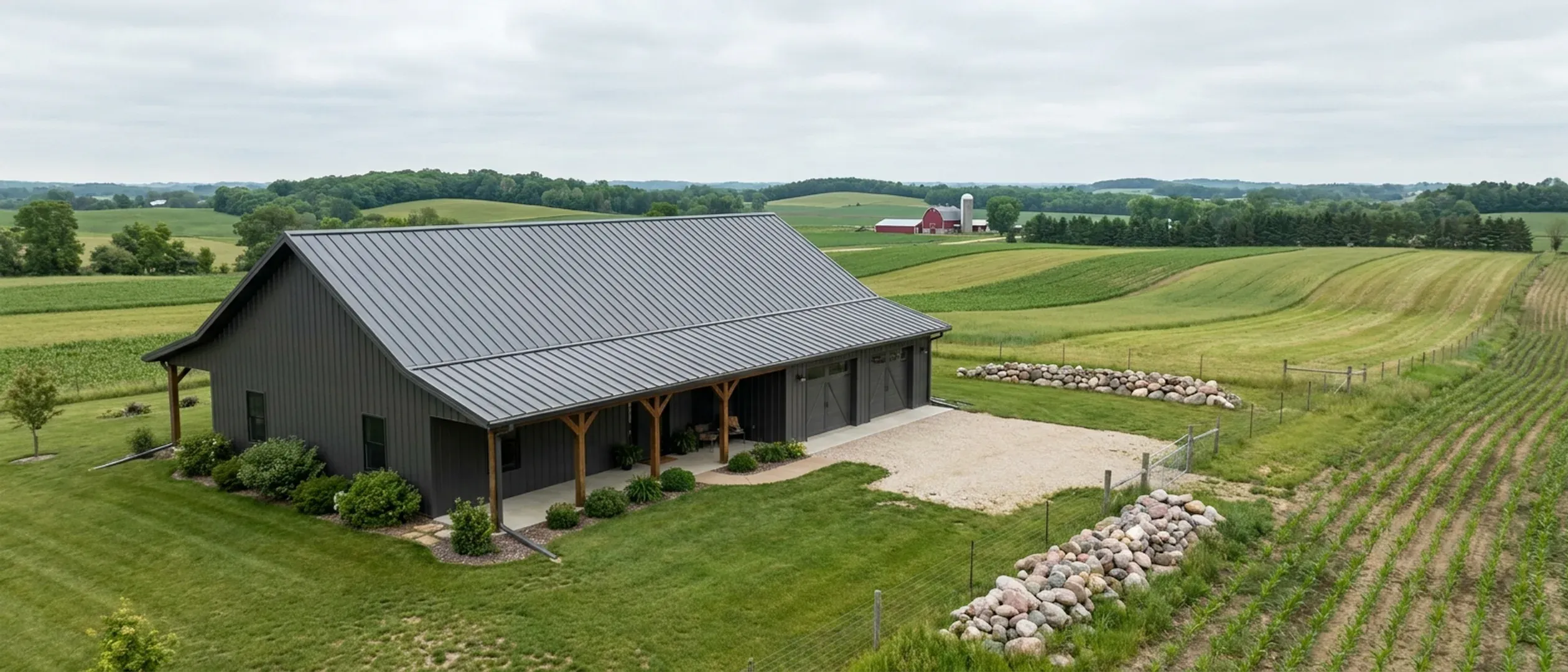
Barndominium Financing in Wisconsin: Construction Loans, USDA, WHEDA and Farm Credit
Most people cannot walk into a bank with a barndominium plan and a standard mortgage application. A home that does not exist yet is financed with a construction loan, and a home with few comparable sales nearby needs a lender comfortable appraising it. Wisconsin has lenders that publish exactly that product for rural homes, a federal rural housing program whose rules allow new construction, and a state housing authority whose programs are mostly built around purchases. This guide lays out what each one says in its own published terms.
Figures on this page are cited third-party or government data, not a quote from Wisconsin Barndominium Builders.
Bottom Line Up Front
- The usual route is a single-close construction-to-permanent loan: one closing before the build, interest-only payments on what has been drawn during construction, then an ordinary mortgage. Compeer Financial and GreenStone Farm Credit Services both publish this product for rural Wisconsin homes, and Compeer lists barndominiums among the home types its construction loans cover.
- USDA's Section 502 rules allow loan funds to build a new dwelling, both in the direct program (7 CFR 3550.52) and the guaranteed program (7 CFR 3555.101), but income limits, a modest-dwelling test and rural-area and site rules apply, and property used primarily for agriculture is ineligible for a guarantee.
- WHEDA's published first-mortgage programs, WHEDA Advantage Conventional and FHA, list purchase loans rather than construction loans. The appraisal usually matters more than the program: a lender that lends against the lower of appraised value or cost will ask for a bigger down payment if the appraisal comes in low.
What actually moves the number
The appraisal
Construction lenders size the loan against the finished home's appraised value or the cost to build, whichever is lower. Scarce barndominium sales can hold the appraisal down.
Land equity
Land you already own counts toward the down payment with some lenders. GreenStone says the more equity you have in the land, the lower your down payment requirement could be.
Rate lock
Single-close loans can lock the rate before construction. Freddie Mac's weekly survey put the 30-year fixed average at 7.03% in the week of 24 September 2026.
Draws and lien waivers
Construction money is released in draws as work is completed. Lenders ask for a sworn statement of contractors and suppliers and for lien waivers as those parties are paid.
How Midwest custom homes are actually paid for
The Census Bureau tracks how contractor-built homes, custom homes on the owner's land, are financed.
Conventional loans lead
Of contractor-built Midwest homes completed in 2025, 59% were financed with conventional loans, according to the Census Bureau. That category includes the construction-to-permanent loans Farm Credit lenders and banks make.
More than a third paid cash
The Census Bureau counts 36% of those homes as paid for in cash. Many owners sell a previous home or use savings, sometimes after construction has been financed another way.
FHA and VA are small shares
FHA-insured and VA-guaranteed loans each financed 2% of contractor-built Midwest homes completed in 2025, per the Census Bureau. Few custom builds use either.
What that means for a barndominium
A barndominium is financed like other custom homes: mostly conventional construction loans and cash. The difference is the appraisal, because a lender needs comparable sales to support the value.
Farm Credit and rural construction lenders in Wisconsin
Farm Credit associations lend on rural homes as well as farms. Two publish construction loans for Wisconsin homes.
Compeer Financial
Compeer describes its territory as 144 counties across three states, Wisconsin among them. Its construction loan page offers a one-time close construction loan that converts to a regular mortgage when construction is complete, interest paid only on funds disbursed during construction, an upfront rate lock, and specialized construction loans for barndominiums. It also says it allows clients to act as their own general contractor.
GreenStone Farm Credit Services
GreenStone says it serves customers in northeast Wisconsin, with offices including Clintonville, Coleman, Little Chute, Manitowoc and Sturgeon Bay. Its construction loan is a one-time close with an interest-only build period, after which principal and interest payments begin automatically; it lists fixed and variable rate options.
Down payment at GreenStone
GreenStone says it can lend up to 80% of the lower of the as-will-be appraised value or the cost to build plus land value, or up to 95% of the value with private mortgage insurance approval, and it collects the whole down payment for the construction cost at closing.
Land and construction together
GreenStone says a land purchase and construction loan can be combined, or the land bought first and the construction loan rolled into it later if the construction documents are not ready. Compeer also publishes home site loans for buying land now and building later.
What USDA's own rules say
USDA Rural Development's single-family housing programs are written in federal regulation, and those rules decide whether a barndominium qualifies.
Section 502 direct loans can build
Under 7 CFR 3550.52, Section 502 funds may be used to buy, build, rehabilitate, improve or relocate an eligible dwelling for use as the borrower's permanent residence. The household's adjusted income must not exceed the area's low-income limit at approval (7 CFR 3550.53).
The modest-dwelling test
7 CFR 3550.57 requires a direct-loan property to be modest for the area, not designed for income-producing purposes, and within the area loan limit, and it prohibits in-ground swimming pools on new construction. A barndominium with a large commercial shop may fail the income-producing test.
Guaranteed loans can build too
The Single Family Housing Guaranteed program allows loan funds for the construction or purchase of a new dwelling, including site preparation such as grading, foundation and driveways (7 CFR 3555.101).
Site rules for guaranteed loans
Under 7 CFR 3555.201 the site must be in an area USDA designates as rural, typical in size for the area, reachable from an all-weather road, and served by adequate water and wastewater systems; property used primarily for agriculture, farming or commercial enterprise is ineligible. A hobby farm with a barndominium on it needs a careful conversation with the lender.
Appraisal, rates and what to bring to a lender
Most financing problems on a barndominium show up at the appraisal. Plan for it before you apply.
How appraisers pick comparables
Fannie Mae's Selling Guide says comparable sales should have similar physical and legal characteristics to the subject property and should come from the same market area when possible. If similar sales are not available, the appraiser may widen the search and must explain why, and in rural areas with minimal sales activity may not find three truly comparable sales from the last 12 months.
Rates
Freddie Mac's Primary Mortgage Market Survey averaged 7.03% for a 30-year fixed mortgage and 6.42% for a 15-year fixed in the week of 24 September 2026, against 6.30% for the 30-year a year earlier. Construction loans are priced by each lender, and a single-close loan that locks the rate up front removes the risk of rates moving during the build.
What lenders ask for
GreenStone's published construction documents include a dwelling specifications sheet listing the materials and a sworn statement listing each contractor and supplier with its price, which sets the project budget. Expect to bring a floor plan and your land details as well.
Where the gap usually comes from
If the appraisal comes in under the cost to build plus land, a lender lending on the lower figure funds less and your down payment grows. Choosing a floor plan and finish level that local sales support is the most reliable way to keep the two numbers close.
Reading this because you are weighing a build? The next step is a plan drawn for your program.
What's different about Wisconsin
Lien notices and waivers
Wisconsin's lien law requires your prime contractor to include a lien-rights notice in the contract, and subcontractors and suppliers may send their own notices (Wis. Stat. 779.02). Ask for lien waivers with each draw. GreenStone publishes a Wisconsin sworn statement form and partial lien waivers as part of its construction draw process.
The permit comes before the first draw
The Wisconsin uniform building permit must be issued before excavation starts (SPS 320.06, 320.08), and on land without sewer the POWTS sanitary permit comes before the building permit (SPS 383.25(2)). Nothing can be excavated until both are issued, so the permit timeline sits inside the loan timeline.
Who pulls the permit
Wisconsin requires the contractor who pulls the building permit for a new home to hold a State Dwelling Contractor certification and employ a certified qualifier (Wis. Stat. 101.654; SPS 305.31); owner-occupants pulling their own permit are exempt. A lender that allows you to act as your own general contractor, as Compeer and GreenStone both say they do, is lending to an owner-builder under that exemption.
WHEDA is a purchase lender first
The Wisconsin Housing and Economic Development Authority's home-buyer page lists WHEDA Advantage Conventional for purchase or WHEDA-to-WHEDA refinance and WHEDA Advantage FHA for purchase, both 30-year fixed, owner-occupied, with household income limits and minimum credit scores of 620 and 640. It also offers renovation and home-improvement products for existing homes. A construction loan is not on the list, so ask a WHEDA-approved lender whether one of its products can serve as the permanent loan after a build.
Pros and cons, honestly
Pros
- Single-close construction loans are published by Farm Credit lenders active in Wisconsin, including loans aimed at barndominiums.
- Land you already own can count toward the down payment with some lenders.
- USDA's rules allow both direct and guaranteed loans to be used to build a new home in eligible rural areas.
- Some lenders let you act as your own general contractor.
Cons
- Scarce barndominium sales can hold down the appraisal, and the gap comes out of your down payment.
- USDA programs carry income limits, a modest-dwelling test and an agricultural-use exclusion.
- WHEDA's first-mortgage programs are listed for purchases, not construction.
- 30-year fixed rates averaged just over 7% in late September 2026, per Freddie Mac.
Can you get a mortgage for a barndominium in Wisconsin?
How much down payment do I need for a barndominium construction loan?
Can I use a USDA loan to build a barndominium in Wisconsin?
Does WHEDA finance new construction?
Why do barndominiums sometimes appraise low?
Can I be my own general contractor on a financed barndominium?
What are lien waivers and why does my lender want them?
What should I have ready before talking to a lender?
Questions answered? Tell us what you want to build and we will put real numbers against it.
Sources
- U.S. Census Bureau — Type of Financing of New Single-Family Houses Completed (Characteristics of New Housing, 2025) — Contractor-built, Midwest 2025: conventional 59%, FHA 2%, VA 2%, cash 36%. Read 26 Sep 2026.
- Compeer Financial — Home Construction Loans — One-time close; interest on disbursed funds; rate lock; barndominium construction loans; owner as general contractor; 144 counties across three states. Read 26 Sep 2026.
- GreenStone Farm Credit Services — Home Construction Loans — One-time close; up to 80% of the lower of as-will-be appraised value or cost plus land, 95% with PMI; land equity; sworn statement and lien waivers. Read 26 Sep 2026.
- GreenStone Farm Credit Services — Find a Location — Serves northeast Wisconsin; offices include Clintonville, Coleman, Little Chute, Manitowoc and Sturgeon Bay. Read 26 Sep 2026.
- Electronic Code of Federal Regulations — 7 CFR 3550.52, Loan purposes (Section 502 direct) — Read 26 Sep 2026 via the eCFR renderer API.
- Electronic Code of Federal Regulations — 7 CFR 3550.53, Eligibility requirements — Income at or below the area low-income limit at approval. Read 26 Sep 2026.
- Electronic Code of Federal Regulations — 7 CFR 3550.57, Dwelling requirements — Modest dwelling; not designed for income-producing purposes; no in-ground pools on new construction. Read 26 Sep 2026.
- Electronic Code of Federal Regulations — 7 CFR 3555.101, Loan purposes (Single Family Housing Guaranteed) — Construction or purchase of a new dwelling; site preparation. Read 26 Sep 2026.
- Electronic Code of Federal Regulations — 7 CFR 3555.201, Site requirements — Rural areas; typical site size; agricultural use ineligible; all-weather access; water and wastewater. Read 26 Sep 2026.
- Wisconsin Housing and Economic Development Authority — Home buyer programs — WHEDA Advantage Conventional (purchase or WHEDA-to-WHEDA refinance) and FHA (purchase); 30-year fixed; income limits. Read 26 Sep 2026.
- Fannie Mae Selling Guide — B4-1.3-08, Comparable Sales — Read 26 Sep 2026.
- Freddie Mac — Primary Mortgage Market Survey, historical weekly data — 30-year fixed 7.03%, 15-year 6.42% week of 24 Sep 2026; 30-year 6.30% week of 25 Sep 2025. Read 26 Sep 2026.
- Wis. Stat. 779.02 — Construction liens: notice — Prime contractor lien-rights notice.
- Wis. Stat. 101.654 — Dwelling contractor certification — Required to obtain a building permit; owner-occupant exemption.
Keep reading
The pages that answer the next question this one raises.
Cost to build a barndominium in Wisconsin
The published cost figures a lender's budget will be checked against.
Read itHow big can you build for your budget?
Turning a loan amount into square feet.
Read itBarndominium vs. house cost
Where the cost differs, and why the appraisal may not follow it.
Read itBarndominium build timeline
How permits, draws and construction line up.
Read itStart the survey
Tell us about your land and plans, and we will help you assemble what a lender needs.
Read itWant a real number instead of a range?
Start the survey and tell us about your land and what you want to build. Include the county, town and parcel ID if you have them, because in Wisconsin the permit jurisdiction, the soil and the well and septic answers change the budget more than the building does. The survey costs nothing.